← Return to Cheyenne County History Index
Sidney
Cheyenne County
|
This was Indian country when the railroad arrived in this area on its drive west in 1867. After frequent skirmishes between Indians and the railroad workers, the government sent soldiers to protect the end-of-tracks encampment called “Sidney,” for the Union Pacific Railroad president Sidney Dillion. Sporadic troubles continued until the Indians were routed in 1869. In the meantime, the rail-head was on to the west, and with it the unscrupulous portion of the population. By 1870 the citizens of Sidney felt they should be incorporated into the political activities of the state. Thomas Kane was sent to Lincoln to talk with Governor Butler. That August a proclamation was issued making Cheyenne a new county (the whole south half of the panhandle) and designating Sidney as the county seat. Soon there was a school with a dozen children. May 1873 saw the first issue of the “Sidney Telegraph” printed. During the gold rush to the Black Hills, Sidney grew to 3,500, then 5,000, and was a “wide open” town. Liquor, dance halls, gambling, variety shows were open 24 hours a day. Law‑abiding citizens had many problems to contend with. In addition to 1,000 soldiers at the Fort, who sometimes liked to whoop it up, many large freighting outfits had headquartered in Sidney, each with hundreds of workers. It took several thousand men to move the millions of pounds of freight that arrived by train onto wagons headed for Dakota. Come payday, things could get out of hand in a hurry. In the summer of 1876, a host of undesirable characters drifted into Sidney. That’s when “the regulators” organized and were able to persuade them to leave town, making Sidney a fit place to live again. Bad as that was, the next wave was worse — the cowboys from Texas! In the late 1870s and ’80s Sidney was the center of the great cattle range. Horse thieves were also numerous. When horses stolen from the Indian agency were sold openly, there was threat of an Indian uprising. So soldiers from Fort Sidney were asked to step in and clear out the rustlers. In December 1877, a fire burned a good portion of the business district to the ground. By 1882 special officers were placed on the Union Pacific passenger trains between Omaha and Sidney. Any “rough looking character” was arrested and dropped off between stations. By that time there were 200 people buried in “Boot Hill.” Some had died a natural death or accident, some were killed by Indians, several at the end of a rope, but the majority were killed in fights and drunken brawls. Soon things quieted down and “The Telegraph” reported... “if a stranger attended to his own affairs, and kept away from drinking and such, he’s pretty safe from quarrels as if further east...” Many legends have been handed down, such as the great bullion robbery — four bars of gold, worth $80,000, stolen from the freight room when the agent went to lunch. There were several suspects, but the thieves were never apprehended. It is claimed that Buffalo Bill, Wild Bill Hickock, Sam Bass, Butch Cassidy, and Doc Middleton were frequent visitors in town, probably because Calamity Jane resided in Sidney for a time. Noteworthy events include: President Chester A. Arthur, along with General Sheridan, was in town long enough to change engines on his special train in August 1883. Throngs also greeted President Franklin Delano Roosevelt in the late 1930s, following a switching from the Burlington to the U.P. tracks at the east edge of town. A community split during the Ku Klux Klan era was followed by the “Dirty 30s” and the Depression years, but Sidney was planning for the future and went forward anyway. In World War II, the Sioux Ordnance Depot came to the area. This enormous installation northwest of Sidney brought thousands of people to town. Again restaurants were open 24 hours a day, beds were rented by the hour to accommodate the workers on different shifts. The city needed to add utilities — power, water, sewer system, and telephones — and many cement sidewalks. The City of Sidney, present population just over 6,000, celebrated its centennial in 1985. Sidney has had its wild and woolly days, and at times some thought the town would wither and die — when the rail‑head moved on, the fort was relocated, or the Sioux Army Depot closed. Now, in 1988, Sidney is feeling the effects of low wheat prices, the oil bust, the loss of farms, and closing businesses. What was once a grass‑covered, treeless prairie has at times limped, but has survived to become a desirable place to live and rear a family. God has graced our town and with His blessings — WE WILL SURVIVE. By: Audrey J. Buhrdorf, 1403 Osage Street, Sidney, NE 69162 |
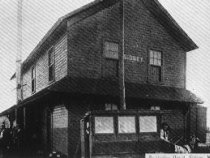
Early Burlington depot and town, 1879.
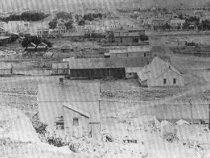
Early Burlington, 1879.
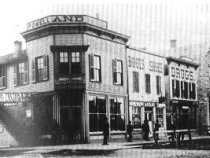
Southwest corner of 2nd and Rose Street, ca.
1890.
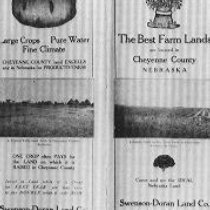
Advertisement brochure published in 1912.
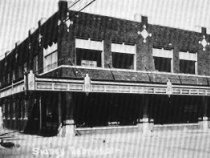
The
old Osborn building on 10th and Highway 30. Ku
Klux Klan meetings were held on the top floor.
|